Friday, June 24, 2016

Building my PBL Learning Design

Now we focus on scaffolding for student independence and ownership, building resilience and an entrepreneurial mindset in general.
Our Design (updated) should ideally provide opportunity for students
  • to identify the questions they would like to pursue (within the context of the Driving Question)
  • to make choices on all key project-related aspects such as resources used, products created, use of time, etc. 
  • to take significant responsibility and work independently from the teacher, but with guidance if necessary
  • to reflect during the project about their own work and learning

Developing Entrepreneurial Skills

resilience

strategies to develop student resilience

What is resilience? It comes from the Latin resilire, “to bounce back”. Resilience refers to the capacity to return to good mental health after challenging and difficult situations. It is not one specific thing, but a combination of skills and attributes that help to solve problems, cope with challenges, adapt and bounce back when things don´t go as planned. Resilient people learn from their mistakes, they look at their failures and mistakes as lessons to be learned from, and as opportunities for growth.

I think that I'm resilient enough myself!

A "Reverse Brainstorming" exercise! In Reverse Brainstorming we will answer the opposite question of what we actually want to achieve. This triggers some unusual thinking and brings a new perspective on the problem. So while we ultimately want to be able to build confidence and independence in our students,  in this Padlet, we identify how we as teachers can weaken our student's confidence and independence. 


An Entrepreneurial Mindset 3.3

I'm glad I have been a member of the "Entrepreneurship in education" etwinning group and lots of what we deal with in this module are more or less familiar to me. Thank you Kornelia!


Developing student-driven activities for PBL

Next to developing collaborative skills of students, another key part of PBL is for students to take ownership of tasks, initiative at solving problems, and most importantly to stick with these tasks and problems until they have come to a satisfactory conclusion. In other words, we try to develop a student-driven environment in which the energy and persistence of what is happening in the classroom does not primarily come from us but from the students. 
Albert Einstein's quote above captures one of the key essences of this module: getting students' to develop grit and resilience to stay with a problem or project even though they have failed previously is one the most difficult parts of PBL and at the core of developing a student-driven environment. As an example and at a quite simple level, when students work for the first time in a group as part of PBL, the first attempts at collaboration might not be successful. It is essential that students don't become frustrated and demotivated but rather excited and motivated to try again and improve, again and again and again. Creating an environment that allows and promotes this, is what the module is all about. 
The learning objectives for this module are:
  1. Understanding the importance of scaffolding the PBL process so that students increasingly develop independence and ownership over the tasks
  2. Understanding the importance of a positive environment and mindset for building student confidence and resilience
  3. Developing a range of activities, strategies and tools that facilitate an entrepreneurial mindset and entrepreneurial skills
Describe a situation in your professional or personal life where you were first unsuccessful but because you stuck with it you succeeded in the end. Finish by identifying why you stuck with the problem/task and did not give up (and make sure to copy your entry also into your Learning Diary).

My first pbl attempts in my classroom feel like unsuccessful so far. But I love the idea and the potentials of it so I keep trying. That's why I'm here. I hope I will succeed in the end. I was stuck so far because I didn't know much. I was mostly driven by my will to do pbl, without having much of knowledge or first hand experience. I'm trying, trying, trying, trying.....

The shared padlet  here:


Sunday, June 19, 2016

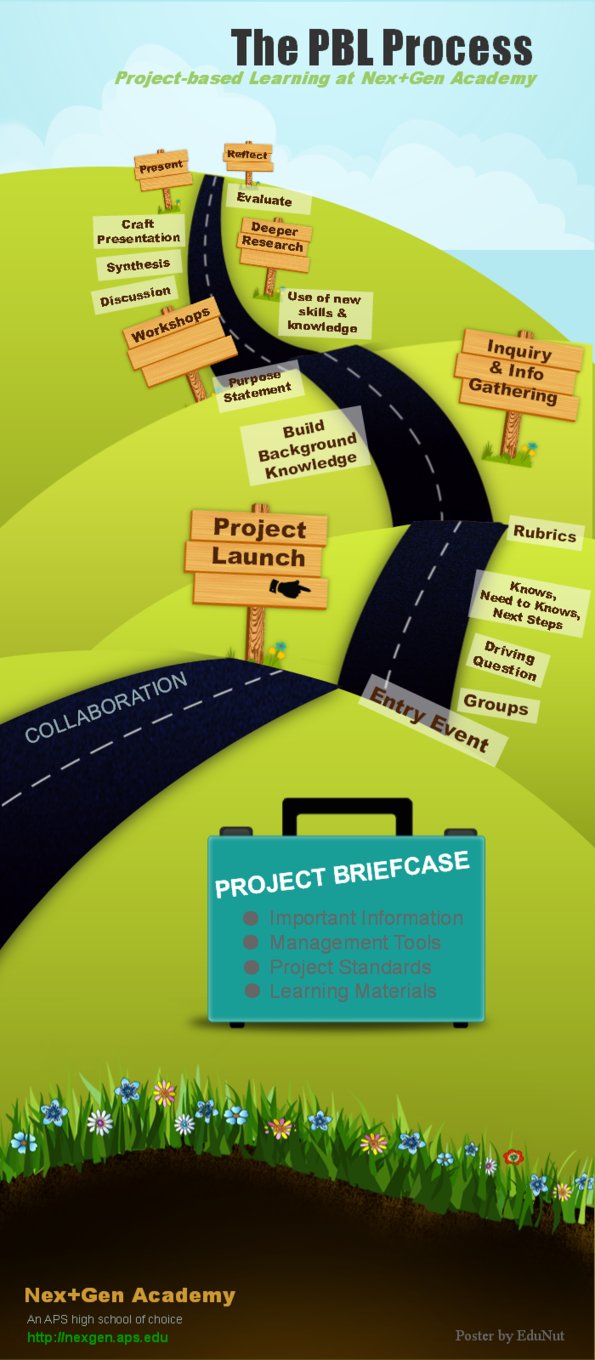
the pbl process


Thank you Aggeliki for sharing this in our twitter #pblcourse

Wednesday, June 15, 2016

original thinking in group works

I came across this article, and couldn't resist to re-posting  the parts that impressed me most. 
How does working in groups contribute to original thinking?
You know, if you look at brainstorming research, we’ve got, now, almost half a century of experiments and field studies. What you see is that if you take five students and put them in a brainstorming group together, you will get fewer ideas and less original ideas than if you had taken those same five students and let them work independently, in separate rooms, by themselves.
And teachers find this maddening when they learn about it, because it goes against the idea of teaching teamwork and two heads are better than one. But there a few things that happen that make brainstorming groups less than the sum of their parts.
One is called production blocking, and it’s the basic idea that we can’t all talk at once. And as a result, some ideas and some students just don’t get heard. Two, there’s ego threat, where kids are nervous about looking stupid or foolish, so they hold back on their most original ideas. And then, three is conformity. One or two ideas get raised that are popular. Everyone wants to jump on the majority bandwagon, as opposed to bringing in some radical, different ways of thinking.
You put kids in separate rooms, what you get is all of the ideas on the table, and then you can bring the group together for what the group does best, which is the wisdom of crowds. The evaluating. The idea selecting. The figuring out which of these ideas really has potential to be, not only novel, but also useful.
And I think that’s where you teach kids to work together effectively in groups. You say that individual idea generation works together really well, but then the group can come together to figure out which ideas to really bet on.
That technique is actually called brain writing. Instead of brainstorm. It’s a great term and I think we should do more of it.
Procrastination can lead to originality. What do teachers do with this? What have you done with it in your classroom?
Look, let me confess. I am a precrastinator, not a procrastinator. That’s an actual term for someone who likes to dive into things as early as possible and finish them ahead of schedule. And I have always worn this like a badge of honor. I finished my doctoral dissertation two years before it was due. I wrapped up my undergrad college thesis four months before the deadline. And I thought this was a great way to be productive.
And then I found that precrastination is a virtue for productivity, but it’s kind of a vice for creativity. I had a student who did all this research in a bunch of companies showing that precrastinators like me, who did everything early, were less creative than people who procrastinated, as rated by their bosses.
And then we followed up and did some experiments where we randomly assigned people to procrastinate, which is a fun task. After a lot of follow up research, what we discovered was great originality comes from being quick to start but slow to finish. That when you dive right into a task, you close yourself off to incubation. If you finish early, you’re stuck only with your most conventional ideas, your first ones. You never have time to think outside the box.
You also tend to think much more in linear, structured ways, as opposed to making these random connections and unexpected leaps that you do when you’re putting off the completion of a task. So the lesson here is that you want to give students time to let ideas marinate.
So when you’re working on a creative project, having a due date that’s a couple of hours later isn’t always the best way to go. And that sometimes what you can do is you can assign a task. You can have them work on it. And then you can extend the deadline and say I want you to go back to the drawing board and consider all those unexpected ideas that you just didn’t have time to look at before.
And then there’s an opportunity to open up a little more original thinking than they had before, but of course, if they procrastinate to the last minute, they’re not going to be creative either because then they just have to rush to panic to do the first ideas as opposed to the most novel ideas.
by Adam Grant, a professor at the Wharton School of the University of Pennsylvania, author of the book "Originals". 

Tuesday, June 14, 2016

Collaboration tools 2.5

TeamUp! yes!
A tool that I have used and it's fun, unless there is an internet connection problem...


And here is what my classmates are proposing as collaborative tools. 


Finding collaboration partners outside the classroom 2.4

Reflecting on which people from your community you or your students could engage with. 

Reminder: My teaching subjects  are related to agriculture.
Think about if you have contacts to or knowledge of networks of local professionals? 
I do know local professionals, agronomists and farmers.
Which organisations or people engage with the school on a regular basis? 
Only educational authorities and pedagogic counselors. If we want to collaborate with professionals we need special permission from our educational authorities, justified by the pedagogic counselors. A lot of bureaucracy that demotivates us. 
Are there any businesses working with the school such as caterers, IT companies, or sports organisations? 
Businesses? No! The school seems isolated from the community. But we can organize educational visits. 
Who are your school's neighbours? 
Ordinary people.
Could they be approached? 
Yes, by us. To enter the school they need the special permission mentioned above. Students can get in contact with others only after school and with their parents permission, in the frames of some project.
What about school alumni? 
That's a bit easier.
And who could you or your students ask for support in identifying the right people? 
Collaborating with parents or with the parents' association can be fruitful.
It's much easier to communicate and exchange with businesses and professionals by social networks, online. It has happened to me to ask for support from a software company  from Australia and get it. Technology can facilitate collaboration.
Linking school with the real world is very important but we  need more flexibility. Our needed working hours end up in surpassing the day-light time. How many pbl approaches can we implement when we teach 5-6 different subjects, in the frames of a full time timetable and how much time do we have to invest, out of school to get prepared? Wondering... 

Monday, June 13, 2016

Effective Collaboration for PBL inside the Classroom 2.3

"Collaboration does not just happen, it needs to be learned and we canprovide our students with the environment and the scaffolding to help them become effective collaborators." 

Watching this video on structuring collaboration for students success ...

....I remembered the dizziness at the end of a project based class, after the endless movement from group to group to explain, help, facilitate. Madness but creative madness! :)

Ideas for developing collaborative skills... ?
I love the "chopstick challenge"!
This is my contribution to the dotstorming

and here is an idea that I liked
 and I could combine with my method of creating the teams. Instead of announcing the members of each team, they could discover them while searching for their "relatives". Cool!